


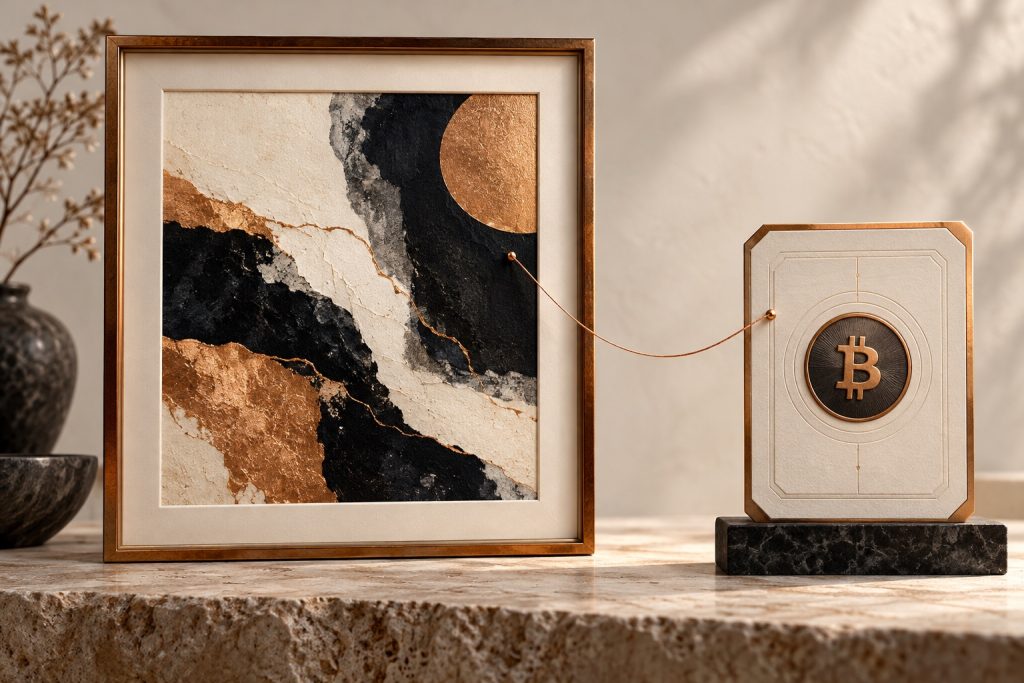
An NFT is a blockchain token that can be distinguished from other tokens. It can reference artwork, access rights or another item, but buying the token does not automatically give you copyright, permanent file storage or a guaranteed resale market.
This educational guide explains the mechanism and the questions to ask. The illustration is conceptual and does not depict a real collection or marketplace.
Identify the network, contract and unique token.
Read the license and service conditions.
Check storage, permissions and resale assumptions.
What “non-fungible” means
Fungible units are treated as interchangeable within their system: one unit can substitute for another of the same kind. A non-fungible token has a distinct identity that applications can track separately. In a common Ethereum NFT design, the contract address and token identifier identify a particular token.
That identity is a record, not a valuation. Two visually similar NFTs can have different identifiers; several tokens can reference similar or identical media. “Unique” therefore describes how the token is distinguished, not proof that no one else can display the image.
For context, our Bitcoin and altcoins guide explains native coins and contract tokens. The distinction matters because an NFT and the coin used to pay its network fees are different assets.
The four layers behind an NFT
| Layer | What it tells you | What to inspect |
|---|---|---|
| Token record | Which address holds a particular token. | Network, contract and token identifier. |
| Metadata | Descriptions and references associated with it. | Where metadata lives and whether it can change. |
| Media or service | The artwork, game item or access experience. | Hosting, availability and dependence on an operator. |
| Rights and terms | What the holder is permitted to do. | The actual license, restrictions and transfer conditions. |
A marketplace may display these layers as one product page, but they need separate questions. A transferable token can remain on a blockchain even if the website interpreting it closes. Conversely, seeing an image in an app does not tell you which rights accompany its token.
What you own—and what you should not assume
Holding an NFT generally means the relevant contract records your address as its holder. The associated terms may grant additional permissions, but the token alone does not explain the scope of those permissions. Read the license instead of assuming that purchase includes commercial reproduction, trademark rights or exclusive access to the underlying image.
Before paying, ask whether the issuer had authority to offer the content in the first place. A copied image and a newly created token do not establish the creator’s consent. A familiar collection name or convincing presentation is not a substitute for checking provenance.
Access rights also depend on the service offering them. If a token unlocks a community or game feature, ask who operates that service and what the terms say about continuity. A blockchain record cannot force a business to keep running indefinitely.
Where the image actually lives
Some NFTs store substantial information on-chain; others reference metadata or media elsewhere. A conventional web address depends on the host. A content-addressed reference such as IPFS identifies content by its data, but continued retrieval still requires someone to retain and serve that data.
Pinning is one way IPFS users preserve content on a node. It is not a promise that every file mentioned in an NFT will remain available forever. Check whether the media is stored, who maintains it and whether the project explains its persistence plan.
Also distinguish a fixed reference from a changeable one. If an administrator can alter a token’s metadata location or another component controls what the page displays, the presentation may change while the token identifier stays the same. That can be useful in some applications, but it should be understood before buying.
Uses beyond a collectible image
An NFT can be used as an application-readable record for a collectible, a membership or a game item. The meaningful question is what the implementation actually delivers. A membership needs a service that recognizes it; a game item needs a game that supports it; a collectible needs provenance that buyers can evaluate.
Transferability can be useful when a service intentionally supports a secondary holder. It can also conflict with identity-based access or restrictions. “Blockchain enabled” alone does not establish that the token is the best design for the use case.
Royalties need similar care. The ERC-2981 standard communicates royalty information, but does not itself force every sale venue to pay it. A creator’s expected income depends on the relevant implementation and marketplace behavior, not just a royalty percentage shown on a page.
Understand the complete cost and the exit
| Cost or constraint | Why it matters |
|---|---|
| Purchase price | The seller’s asking price is not proof of market value. |
| Network fees | Transactions and contract interactions can require separate fees. |
| Marketplace charges | Buying or selling can incur platform-specific charges. |
| Currency exposure | The coin used to price the NFT can change in value. |
| Liquidity | A listing is not a buyer; you may be unable to sell at the displayed price. |
Use a small hypothetical example: a token priced at $40 with $8 in transaction costs requires $48 before any later sale costs. That is a cost illustration, not a current fee quote. If there is no willing buyer later, the existence of a token does not produce an exit.
Compare the total amount at risk with the actual use or experience you want. Avoid treating an advertised floor price as money you can certainly recover. Collection-level statistics do not necessarily describe demand for your particular item.
Wallet permissions deserve a careful read
Buying, listing and transferring can involve different requests. Some contract approvals authorize an operator to move tokens; a signature can authorize an action even when it does not immediately display a network fee. Do not assume that “just signing” is harmless.
Check the network, contract, requested permission and destination before confirming. An unsolicited token in a wallet is not an instruction to visit a claim website. Keep recovery phrases private and avoid connecting a wallet with valuable assets simply to inspect an unfamiliar offer.
Our Bitcoin guide introduces private keys and custody, while the first-purchase guide explains the difference between a platform balance and assets controlled through a wallet. The underlying security habits remain useful even though NFT contract interactions add their own complexity.
A practical checklist before buying
Identify exactly what you are purchasing: the token, its referenced content, the permissions and any service dependence. Check the issuer’s provenance, metadata controls, storage explanation, total transaction cost and realistic resale options.
Then ask the most useful question: would you still want this item if you could not resell it? For a collectible or membership, that helps separate personal use from an unsupported expectation of profit. If the project cannot explain the rights or the service, a polished image is not enough to fill the gap.
Frequently asked questions
Does buying an NFT give me copyright?
Do not assume it does. Inspect the actual rights and license offered with the token; token ownership and rights in the associated work are separate questions.
Can someone copy an NFT image?
A displayed image can often be copied. Copying media does not by itself transfer the original token or its contract record.
Is an NFT always stored entirely on a blockchain?
No. Metadata or media may be referenced elsewhere. Inspect the implementation and who maintains access to the files.
Does IPFS guarantee permanent storage?
No. Content addressing identifies data, while availability depends on nodes retaining and serving it. Check the persistence arrangements.
Are NFT royalties guaranteed?
No universal guarantee follows from the token. Standards can communicate royalty information, but payment depends on the sale mechanism and its enforcement.
Can an NFT be valuable without being an investment?
A holder may value an artwork, collectible or supported access benefit. That personal use does not establish a reliable resale price or investment return.