


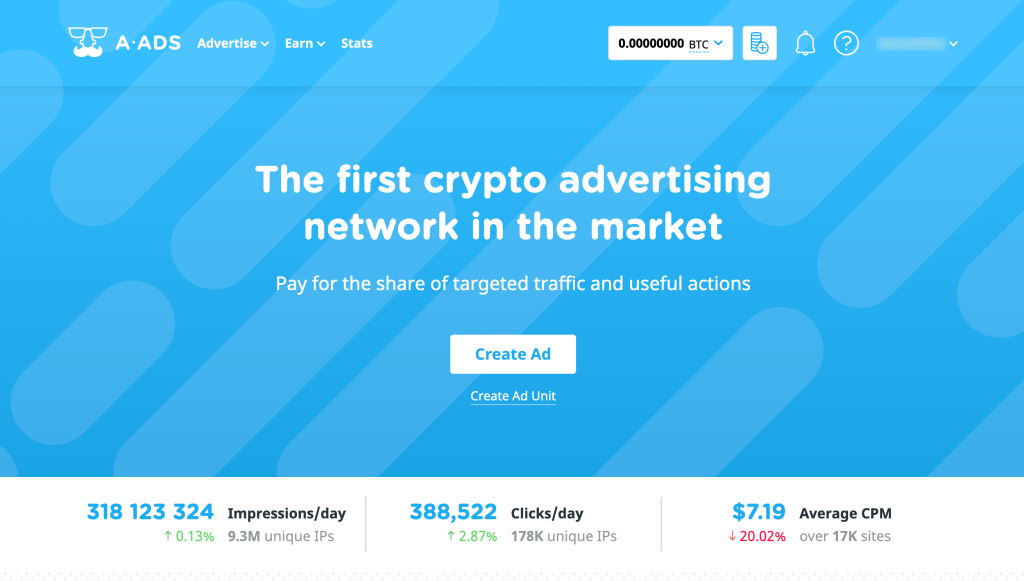
Running a website gives you plenty to do before you even start looking for advertisers. Promoting a crypto product brings a different problem: finding people who understand what you offer. AADS connects those two needs, giving publishers a way to offer advertising space and advertisers access to a network with strong crypto roots.
The name may be unfamiliar, but the project dates back to 2011. A contemporary Bitcointalk announcement introduced Anonymous Ads; the network later became known as A-ADS and announced its move to the AADS brand in August 2025.
At BitcoinLink, we like the practical proposition: self-service advertising tools combined with Bitcoin payments. We explored the public site, campaign and ad-unit forms, help articles and user feedback. We did not purchase traffic or complete a payout, so this review assesses the offering rather than claiming measured campaign results.
Our view: AADS is worth trying for an eligible website or a crypto business with a defined acquisition budget. Choose the useful starting point for your situation: create an ad unit or prepare a targeted campaign.
BitcoinLink may earn a commission when you use certain links on this site. This helps fund our editorial work. It does not make a service suitable for everyone: our reviews cover its benefits, limitations and conditions to understand before signing up.
What does AADS actually do?
AADS is an advertising network. Advertisers fund campaigns, publishers supply space, and the network distributes advertising revenue. Bitcoin is a payment and payout option; this is not an exchange account for buying coins.
Its long history is encouraging for a lesser-known service. We place more weight, however, on the controls you can use today and the results you can measure on your own website. Older A-ADS reviews may describe the same network with outdated fees or eligibility rules.
Who should consider an account?
| Your situation | Useful feature | First objective |
|---|---|---|
| Crypto publication, blog or web tool | Advertising space for relevant campaigns | Measure actual ad-unit earnings |
| Product serving crypto users | Category and publisher selection | Track qualified signups |
| Publisher selling media partnerships | Marketplace offers | Define a clear deliverable and price |
| Audience of potential advertisers | Referral program | Refer active new advertisers |
A Bitcoin publication, wallet comparison site or portfolio tool has an understandable reason to explore AADS. For a general consumer business, we would inspect the available publishers before deciding whether the audience fits.
Publishers: turn existing traffic into an advertising opportunity
You create an ad unit, choose its format and embed the supplied code. AADS describes an iframe-based integration. The public form offers adaptive or fixed sizes, desktop and mobile settings, and exclusions for categories including investments, gambling, NSFW content and risky projects.
Those exclusions matter. The advertisements readers see become part of their experience of your website. We would begin with a visible, unobtrusive placement and content settings that match the publication. Stricter filters can reduce available advertising demand.
Small websites still need to meet the rules
AADS says low-traffic sites can join. Its current eligibility guide nevertheless requires a domain registered at least three months earlier and excludes sites on free domains or subdomains, citing Wix and Blogspot. Sites must remain accessible and offer appropriate content without artificial traffic or excessive intrusive advertising.
The attraction is being able to consider monetization before building a huge readership. Eligibility and meaningful earnings are separate questions.
Detection comes before earnings
An ad unit must be detected by AADS before revenue can accrue. Check detection and categorization after installation, including after changes to caching or page layout.
The earnings calculator provides estimates, not a fixed price for every click or thousand views. Revenue depends on valid traffic, advertiser demand and the match between campaigns and your space. An initial forecast should help you plan a trial, not become an income promise.
Already have a website with real readers? Create your first AADS ad unit and check its detection. That gives you a concrete way to judge the network against your own audience.
Advertisers: choose the audience before chasing impressions
The campaign form offers ready-made traffic packs and manual catalog selection. During our visit, themes included crypto media, crypto tools, trading and blockchain projects, alongside language selection.
Packs make preparation easier. For an initial campaign, we would usually prefer a focused selection: a portfolio application and a Bitcoin conference may need different publishers and landing pages.
How the daily budget works
The default model is CPD, or cost per day. Your daily budget buys a share of selected traffic in competition with other advertisers. It does not automatically reserve a fixed number of clicks or registrations.
The form includes daily budgets fixed in BTC or USD, a total budget and a maximum CPM setting. Documentation explains that Max CPM filters out ad units whose effective cost exceeds the limit. Sources can also be excluded as you evaluate their usefulness.
Measure the action that matters
Prepare a landing page and your own conversion measurement before funding the account. Track the outcome you need: a newsletter subscription, product registration or relevant inquiry. Compare AADS reporting with your own measurements and review any discrepancy.
Our suggested starting point is one objective, a capped total spend and a small set of relevant sources. A low CPM is valuable when the visitors help your business.
Have a product for crypto users? Prepare a targeted AADS campaign with a spending limit. Increase the budget when the results support that decision.
Fees and minimum deposits
AADS states a 20% commission, with 80% of advertising budgets going to publishers. On a $100 budget subject to this rule, $20 is the network commission and $80 is allocated to the relevant publishers. That is not a $80 income promise for a single website. Marketplace documentation also states that publishers receive 80% of their offer price.
The published minimum deposit is $100, or more depending on the coin and network. The help article gives $250 for USDT on ERC-20 as an example. Check the deposit window for the current threshold and conversion.
A deposit funds your balance; a daily budget controls how quickly a campaign spends it. A small daily budget does not reduce the minimum deposit. Review payment and network costs in the actual transaction summary.
Bitcoin payouts and the appeal of Lightning
Advertisers can fund accounts using crypto or bank cards, subject to the options and terms shown in the payment flow. Always use the current deposit address and correct network.
Publisher withdrawals support Bitcoin on-chain and Lightning. The guide states a 0.001 BTC minimum for on-chain withdrawals and describes Lightning as allowing smaller amounts without that threshold. The supported receiving methods include Lightning Addresses and LNURL payRequest.
For a smaller publisher, that is a meaningful feature: being able to receive modest earnings makes a trial more practical. Check wallet compatibility and withdrawal settings first. AADS states it does not charge its own withdrawal fee; that does not guarantee every payment step is cost-free. Changing withdrawal settings may also trigger a temporary security hold.
Marketplace, CPA and referrals
Purchase a defined placement
The marketplace includes articles, social posts and other media placements alongside banner opportunities. Review the deliverable, placement, duration and acceptance terms rather than choosing on audience estimates alone. A sponsored article does not guarantee sales or SEO gains. Publishers should price offers with the commission in mind.
Reward useful actions
AADS also supports CPA and revenue sharing. These arrangements can require technical integration and reliable goal tracking. They suit businesses able to define and measure a conversion and should be distinguished from standard daily-budget banner campaigns.
Refer new advertisers
The referral program advertises 10% of referred new advertisers’ spending for six months, subject to its terms. Earnings depend on those advertisers becoming active; sharing an invitation does not itself create income.
Privacy and user feedback
AADS promotes anonymous account options, reflecting its Bitcoin heritage. Additional requirements can apply to certain advertising or publishers: the help center specifically mentions KYC for targeting Poocoin. The privacy policy also describes processing account and payment-related information. We would not describe the entire service as universally free of data collection, cookies or identity checks.
Public feedback is mixed. Some reviewers appreciate support and payouts; others challenge traffic measurement or campaign visibility. These accounts cannot establish what your campaign will achieve. They make a clearly measured first campaign or ad-unit trial especially useful.
Getting started
For publishers
- Check domain and content eligibility.
- Follow the account access flow and preserve your login details.
- Create an ad unit with a suitable size and content exclusions.
- Embed the code and verify detection and categorization.
- Set a compatible payout method and observe actual earnings.
For advertisers
- Define one useful conversion.
- Prepare matching ad creative and a landing page.
- Select sources and language, then cap daily and total budgets.
- Check advertising rules, minimum deposit and payment terms.
- After moderation and launch, compare conversions and refine sources.
Documentation describes email-based account access as well as accounts associated with campaign or ad-unit creation. Follow the instructions in the current flow, particularly when preserving access to an anonymous account.
BitcoinLink’s verdict
We would put AADS on the shortlist for an eligible crypto publisher. Self-service placements, content exclusions and Lightning payouts address a real need for independent websites that want to monetize without managing every advertiser relationship themselves.
For advertisers, its strongest case is a crypto-focused acquisition plan with enough budget to evaluate a campaign properly. Publisher selection and qualified conversions deserve more attention than headline impression counts.
If that matches your project, create your AADS account and prepare your first ad unit or campaign. A clear first objective will make the service much easier to assess.
Frequently asked questions
Are AADS and A-ADS the same network?
Yes. A-ADS, originally Anonymous Ads, announced the AADS rebrand in 2025. Older descriptions may have outdated conditions.
Do publishers need large traffic volumes?
AADS says low-traffic websites can join, subject to domain and content requirements. Smaller audiences generally offer less revenue potential; earnings are not guaranteed.
What is the minimum advertiser deposit?
The guide states $100 or more depending on coin and network, with $250 for USDT ERC-20 as an example. Check the deposit window.
Does AADS pay a fixed amount per click?
No fixed CPC or CPM is guaranteed. Revenue depends on budget allocation, valid traffic and demand. Separate CPA arrangements can reward defined actions.
Can publishers withdraw small Bitcoin earnings?
AADS presents Lightning as the option for small amounts. Its stated on-chain Bitcoin minimum is 0.001 BTC. Receiving compatibility and security holds still matter.
Is AADS always available without KYC?
Anonymous options exist, but particular campaigns or publishers can impose additional checks. Universal no-KYC access should not be assumed.